Showing posts with label songs. Show all posts

Tuesday, 30 August 2016

Nga Manu Rima - 100 Days Project: Mat time resources

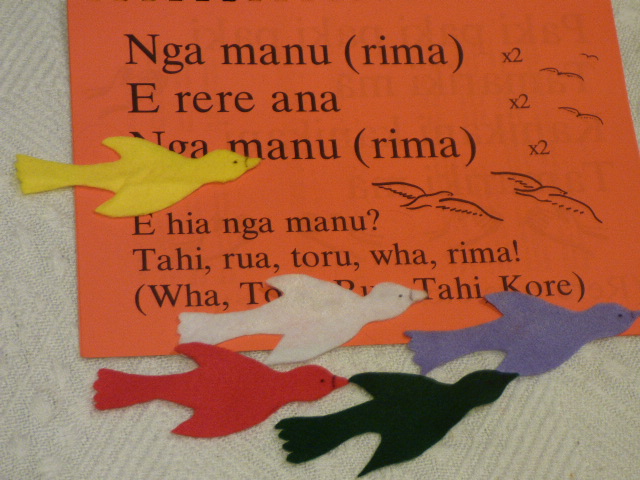
 Today's mat time resource is a lovely little counting song in Te Reo Maori called Nga Manu Rima (5 Birds).  You can find the song on Nga Pihi 2 Songbook. This was a quick project to complete, with only having to make 5 birds which are cut out of felt. 

Click on the link for more of my teaching resources

Tuesday, 12 July 2016

Songs for Transition Times

This is a collection of songs and rhymes that you can use at the end of mat time to send children off to wash their hands for meal times.  It is good to widen the repertoire, and I am trying to extend my own repertoire so that I don't rely on the same song or method all the time.

If you are looking for songs for mat time, you can find action songs for young children in the link for action songs suitable for mat time;
There is a range of counting songs here;
You can find Te reo Maori waiata in this link.
And you can find a collection of mat time games here.


Williby Wallaby 
This is a rhyming song, that is a fun introduction to rhyming words.

Williby Wallaby Woo
An elephant sat on you
Williby Wallaby We
An elephant sat on me

Williby Wallaby Wacob
An elephant sat on Jacob
Williby Wallaby Wim
An elephant sat on Kim

(substitute a W for the first letter of the child's name)
When the child's name is called, they stand up and go and wash their hands.


Peanut Butter, Marmalade and Jam

Peanut butter, marmalade and jam
(Child's name) and (child's name) go and wash your hands.

I also do an alternative version...
Peanut butter, marmalade and jam
(Child's name) choose a friend and go and wash your hands.


Cars and Motorbikes

Cars and motorbikes, trucks and vans
(Child's name) and (child's name) go and wash your hands.


Rub and Scrub  (Tune: The farmer in the dell)

(Child's name) wash your hands, (Child 2's name) wash your hands
Rub and scrub, rub and scrub,
Wash both of your hands.


If Your Name Is... (Tune: If You're Happy and you know it)

If your name is ......., go wash your hands
If your name is .......... go wash your hands
If your name is .......... and your name is ................
If your name is ............ go wash your hands.

Other alternatives to the same tune....

If your name starts with A go wash your hands
If your name starts with A then go and wash your hands
If your name starts with A go wash your hands

You could change each line to a different letter of the alphabet, but it would be rather quick and you could end up sending lots of children all at once to the bathroom.  By repeating the same line, you are giving the slower children a chance to get up and go before going on to the next letter/colour.

If you're wearing blue, go wash your hands
If your're wearing blue, go wash your hands
If you're wearing blue, then go and wash your hands
If you're wearing blue go wash your hands.


Jack In The Box
All children to crouch down on floor...

Jack in the box, jack in the box
Quiet and still
Who will come out to wash their hands
......... will!

You could go round and touch children lightly on their backs as you say their name


This Is The Way We Wash Our Hands (Tune: Here we go round the mulberry bush)

You could do this song by starting off dancing around in a circle.

........ go and wash your hands, wash your hands, wash your hands
......... go and wash your hands, and make them clean and dry.

........ go and wash your hands, wash your hands, wash your hands
......... go and wash your hands, and make them clean and dry.

Call a different child's name for each line.


Other ways to send children off to wash their hands...

Little Seeds
Children crouch down like little seeds.  Come around and pretend to water each child, saying "Grow, grow, grow, go and wash your hands".

Hatching Eggs
This is great if children are interested in dinosaurs, birds, dragons, reptiles... anything that hatches out of an egg.  Children crouch down pretending they are inside an egg.  Go around to each child, gently tapping them on their back and saying "Crack, crack, come out of your shell and go wash your hands".

Sleeping Princesses/Princes (or giants, dragons, taniwhas, lions, tigers, or any animal they choose)
Cast a magic spell and put all the children to sleep.  Come around and gently wake each child up with your wand, sending them to go wash their hands as they wake up.


Te Reo Maori
To say "Go wash your hands" in Te reo Maori is: "Haere ki te horoi o ringaringa"


Monday, 11 July 2016

Dinosaurs


Dinosaurs are a very common theme that occurs regularly in early childhood - and I remember being fascinated with dinosaurs as a child.  It is worthwhile making resources for these re-occurring themes to engage children, foster a love of learning and fascination and wonder, and provide a range of different ways for children to learn.

I made up this super simple counting song in the shower - my thinking space! It is to the tune of 10 Little Indians...

Small World Play


One of my teachers found this set of dinosaurs on sale for only $12 so she grabbed them and set up this small world play area. It was simply some sand, dinosaurs, and she made signs by printing out the names of the dinosaurs and laminating them, and stuck them to craft sticks.  One of the children helped with the naming of each dinosaur (they have such incredible knowledge of these things!).

It was wonderful to see some children who are generally found playing in only one area, suddenly playing in the Dinosaur Kingdom, talking and making up stories, and sharing, co-operating and role playing with others.

Dinosaurs on the Playdough Table

This was simply dinosaurs, playdough (or dough made from cornflour), some plastic trees, a bowl of sand and a bowl of glitter.  You could add leaves, grasses, and sticks to this.

The dinosaurs stomped in the playdough soon after I set it up, leaving their footprints behind.  

Dinosaur Board Game


I created this Dinosaur Board Game to follow on with the children's love of board games and games, and their interest in dinosaurs.  I used a large(ish) piece of matboard, drew the tiles on it and the children coloured it in.  I printed off some pictures of dinosaurs, which the children cut out and stuck on where-ever they wanted.  The footprints pointing the other way means you have to move backwards if you land on them.  You need counters and dice, and you throw the dice and move your counter along the path until you reach the safety of the cave.  First person to finish, wins.


Saturday, 18 June 2016

Space Theme

 The children are currently interested in Space - planets, stars, rocketships, and aliens.  There is a fantastic song on Youtube, The Planet Song that teaches facts about the planets - and another one about the Dwarf Planets.  One of my favourite songs is another educational song by They Might Be Giants - Why Does The Sun Shine?

Galaxy Bottles

 As part of our interest in Space, I made Galaxy bottles with the children.
We used:
Empty plastic bottles
Synthetic stuffing (you could use wool roving, unspun sheeps wool, or cotton wool balls)
Water storage crystals - the kind you put into your pots when gardening, to retain water during the hot sumer months.
Acrylic Paint - I used purple, dark blue, burgundy and black. You could use food colouring instead.
Water
Jugs
Teaspoon
Glitter
Star sequins


Mix a bit of paint with water.  You can use a lot of water with acrylic paint. Have jugs of each colour available for children to pour into their bottles.

Layer in paint/water; water crystals; wool/stuffing; another paint colour; more wool /stuffing / water crystals / another paint colour.
The wool/stuffing helps to keep the colours of paint separate so that you retain the different colours within the bottle.
Don't fill the bottle right to the top - allow time and space for the water crystals to expand. I ended up pouring out a bit from each bottle and filling up an extra bottle with the excess.
Add glitter and star sequins.
This is great for children developing their fine motor skills - pouring, scooping, measuring, pushing, which are essential for pre-writing.  I found it was easier to use a pencil or the handle of a paintbrush to push the stuffing into the bottle.


 Ice Cube Stars

 I found these ice cube stars at The Warehouse for $2 a bag. They are the sort with water in, that you freeze and pop into your drink.  I thought they were perfect for a bit of fun with ice.
 I cut up 2 litre plastic milk cartons and used the bottoms as containers for making large blocks of ice.  I put in the ice cube stars and a bit of blue glitter and put in the freezer to freeze.

It then provided children with sensory exploration, scientific exploration, numeracy (counting how many stars they could see in the blocks, as well as how many stars they managed to get out); vocabulary - hard, melting, frozen, clear, wet, slippery, etc; sorting of colours; comparing whose block was the biggest, etc. We also talked about constellations, as each block resembled a constellation of stars.  We talked about how Matariki is a constellation of 7 stars, (actually it's 9 stars according to some) so children began counting to see if they had 7 stars like Matariki.
You can add salt to the children's ice experiments but I didn't do that with them today.

Bottle Rockets


These bottle rockets were quick and simple to make with a bit of adult help.  You could be fancy and paint the rockets, or you could even put a photo of the child on the rocket! A parent had kindly given us a book of paper samples, including metallic paper, which we used for the circle that we glued onto the bottle.

You will need:
Plastic bottle
Craft knife
Card - parents had recently donated empty cerealboxes, so we used these for our wings.
Pencil
Scissors
Coloured Paper (metallic paper looks great)
Glue

I created a basic template for the wings, and the children  (aged between 3-5) drew around the template and cut them out.  I try to find ways as much as possible for children to do their own work, rather than done by an adult. I like to empower children and let them do it and feel the sense of pride you get when you have made something, rather than when someone else makes it and gives it to you.  I want children to realise that they are capable and able, and to give things a go.  It doesn't matter that it is not perfect.  If a child hasn't cut around the template properly, it doesn't matter - it is their work and that is what is important.  They are learning to use scissors and pencils, and imperfection is part of this learning.

While the children were busy drawing and cutting their wings, I was busy cutting slits in the bottle with my craft knife.  When someone was ready, we inserted the wings into the slits and adjusted the length of the slit as necessary.  We only did 2 wings but 3 would look great as well.  Then the children cut out a circle, and glued it onto their bottle.

While I was having lunch in the staffroom, I was laughing at the sight of children chucking bottles around the playground.  It would look like chaos to anyone who happened to walk into the room. I redirected the random chucking of bottles by grabbing a couple of tires and hoops to be planets, and children stood in one hoop (Earth - Nasa Space Station) and took turn launching their bottles into the tires.
This promoted:  taking turns; waiting; patience; learning about how to keep themselves and others safe; physical skills - aiming and throwing; cheering each other on; good sportsmanship; persistence - not giving up if they don't get their rocket onto Mars; and a feeling of pride when they finally do hit Mars.

Rocket Ship

We are lucky to have parents who donate large boxes to us to use.  We received this wonderful big box and the children helped to make it into a rocket ship.  We had another parent who donated a book of sample metallic paper, so we used that paper to glue onto the outside of the box, and glued a paper plate onto the front of the box.  Two children could fit inside the box and this provided days of fun and counting down from Ten to blast off!

Of course, once we had made the rocket ship, we then needed to make a space control panel....
I made the control panel from two boxes, tinfoil and glue. I put it together, and then I provided glue, brushes and lids to the children to glue on as knobs and controls.  As children were having trouble counting backwards from 10, I made a display on the top of the panel with the numbers on them, to help support counting backwards and number identification.

Some Other Space Crafts...


My colleagues have also been busy doing an assortment of space related crafts to help support children's learning... 

* they painted planets on black card using paint thickened with cornflour

* they made rockets using cardboard rolls, metallic paper, crepe paper, coloured paper and paint

* UFO's made from paper plates, paint and foil paper
* Handprint aliens using hands, paint and googly eyes

* Stars made by bending pipecleaners around a star shaped cookie cutter
* Stars painted on a black background, using a star shaped cookie cutter to trace around, then children painted the inside of the star.  Gold paint mixed with glue in a squeezy bottle was then used to go around the outside of the star. 

Plaster of Paris Moonscapes

This was a great little science experiment that I got from a book full of fun science experiments.
You need:
Plaster of Paris
Hot Water
A foil tray (preferably circular shaped)
A stick for stirring

Pour half a cup of plaster of paris into the foil tray.
Pour hot water over the top (I can't remember exactly how much water - maybe half a cup - 1 cup?)
Stir briefly to mix and wet the plaster of paris. Don't stir it smooth - the lumps will help to form volcanoes and craters, which is what we are after - just like a real moonscape.
Let dry. 
You may need to pour off excess water as it dries.

Jet Packs

I don't have a photo of these, but I made jet packs for the children using two plastic bottles taped together, and wide ribbon attached to go over each shoulder, so they could wear them on their backs. Then they were off running around outside pretending to go to the Moon.


Friday, 17 June 2016

Superheroes


Superheroes have been popular since I was a child. My favourite was Wonder Woman, but I remember watching Batman, The Increduble Hulk, Spider-Man and Lois And Clark on TV, as did all the other children in my class. And these iconic super heroes are still popular, generations down the track. But there are also many other super heroes, and the children at school have recently been talking about PJ Masks, a new Disney superhero cartoon. Earlier this week, the children were pretending to be PJ Mask characters, and running around chasing each other, talking and playing PJ Masks. So I began thinking about how I could help to encourage and promote this interest in superheroes in other areas of play.

I borrowed some little wooden block people from the block corner, went home and created these super simple super heroes from wooden pegs, pipecleaners and felt. I brought these little super heroes into school the next morning, created a cityscape using a few blocks, and this table has been used all day by children making up stories and using the super heroes to save people. 

The great thing is, their simplicity means that children can pretend that they are princesses, queens, Wizards, or super heroes - whatever they want. By limiting the details - I could have drawn symbols on the body, or Spider-Man's pattern, but I chose not to - a block doll with a red cape can be Spider-Man, Superman, Spider Girl, or Owlette from PJ Masks.

Resources required:
Block dolls or wooden pegs
Pipecleaners
Scraps of felt
Marker pens / nail polish / paint
Glue
Needle and thread

For the block dolls, I simply cut a small rectangle of felt and used needle and thread to secure the cape around the neck.

To create the wooden peg superheroes:

I coloured in the red, black and blue pegs using marker pens and coated them with clear nail polish so that the colour didn't come off on little hands. I coloured the green peg using green nail polish. You could use paint as well - it's all a matter of preference and how much effort or time you want to put in.

I didn't do faces, but I did overhear one child saying "he needs eyes, so he can see where he is going!" Faces are a matter of preference also. I like to leave faces blank so that children can use their own imagination - rather than force an expression or emotion on the child, the child can pretend that they are happy, sad, angry, hurt, joyful, determined, naughty, scared, or heroic.

I wrapped a pipecleaner around the neck a couple of times for the arms and secured with a spot of glue.

Cut a rectangle of felt (I use acrylic felt as it is cheaper and doesn't tend to pill) and secure around the neck using needle and thread.

To make the princess above I wrapped a bit of sequinned fabric around the peg with a bit of glue. I cut little holes in the fabric to pull the pipecleaner arms through and secured in place with glue.  Then I used a bit of wide ribbon as the cape.

Super Hero Boardgame

The children have really been enjoying boardgames and card games recently, and they have been bringing them in from home to play.  So I created this Super Hero board game with the children.

We used:
A3 size card.  You could do it on an A3 piece of paper and laminate it, but storage then becomes an issue because it does not fold well.  You could glue an A3 piece of paper into a manilla folder, which then provides a bit of sturdiness but folds into an easily stored A4 size.
Pencil, ruler, and eraser
Marker pen
Pictures of Super Heroes.  I googled images of Superhero clip art, and printed them off.
Scissors
Glue

The children began by cutting out the Super Heroes, while I drew up the game board - I first drew it in pencil, then went over in marker pen once I was happy with the layout.  The children helped me to decide on the design of the game.  The children coloured in the game squares and the city buildings.  We left the outside white, as I thought it would be too confusing to have coloured squares on a coloured board.  Then the children glued the Super Heroes where-ever they wanted on the board.  I used a marker pen to outline the tiles, and wrote the numbers and Start and Finish on the tiles.

You play by putting your counters on the start, throwing the dice and moving your counter around the board.  First person to reach the Finish, wins.

I also created small cards, on which are written Super Hero Tasks.  If you land on a Super Hero, you get a Task Card. Some of these tasks include:

* Strike a Super Hero pose.  Everyone else has to guess who you are.
* Super Heroes have to keep fit.  Everybody run once around the outside playground and come back to your spot.
* Super Heroes are Super Tidy.  Pick up one thing off the floor and put it back in the right place.
* Spiderman has a spider on his outfit.  Draw a picture of a spider.
* Super Heroes eat lots of fruit to keep healthy.  Draw a picture of a fruit and everyone else guess what it is.
* Super Heroes need to stay fit.  Everybody run on the spot for 1 minute.
* Crawl around the room like Gecko and come back to your spot.
* Super Heroes have to be quiet.  Creep quietly down the hallway and back to your spot.
* Shout "To The Batmobile!", run around the circle and back to your spot.
* Shout "Into the night to save the day!"
* Super Heroes need to be strong.  Everyone do 5 press ups.
* Shout "Super heroes to the rescue!" and run to the wall and back.
* Everyone do 5 star jumps.
* Superheroes fly. Run around outside as fast as you can fly.
* Use your ice powers to freeze someone.
* Walk like a spider to the wall and back.
* Shout "Cowabunga, Dude!" and strike your best Ninja Turtle pose.
* Ninja turtles love pizza. Draw a picture of a pizza, filled with your favourite toppings.

These are just ones that I have thought of, but you will probably be able to think of a lot more.  I wanted a range of tasks that promoted lots of different skills, thinking, cognitive, confidence, and physical. The children had great fun playing this game!

Capes

Capes are super easy to make using a rectangle of fabric and a bit of elastic. Stitch the elastic on one end of the rectangle and fasten securely to the opposite side.  Using elastic rather than ribbon means that children can put their capes on and off themselves without needing adult help; also it is not going to get tied in a difficult knot around their necks; and if someone accidentally pulls on their cape, it will be able to stretch and not hurt their neck. I made yellow satin capes, green satin capes, brown velvet capes, pink fur capes, and blue sequinned capes using fabrics that had been kindly donated by parents.  You can use any type of fabric you have got!


Ninja Tag

This has to probably be my best idea ever!  After lunch, the younger children in the other rooms have their sleep, and the active, busy 4 year olds often forget to use their quiet voices when playing outside.  After lots and lots of reminding them to use quiet voices while they were playing tag, I came up with this brilliant idea - Ninja Tag! Just like tag, but SILENT!!!!!  LMAO.  It was hilarious to watch, and more and more children wanted to play - fist-pump moment for me!!!!


Super-Hero Songs

There are some great super-hero songs suitable for mat times  here along with links to listen to the songs.

Ten Superheroes Standing On A Wall       (Tune - 10 Green Bottles standing on a wall)
This is a counting song I made up.  You could get 10 children standing on chairs, and someone in the audience to be the one who says 'help', for the Super-heroes to save.

10 Super-heroes standing on a wall
And if one Super-hero should answer a call
("Help!")
There will be 9 Super-heroes standing on a wall.

Continue until no Super-heroes are standing on a wall.


Saturday, 9 April 2016

Games for Young Children

I wanted to share a range of games that I play with my children. I find I forget games if I haven't played them for a while, so this is a way of documenting a range of games for me to remember, as well as sharing games with others to learn and to play.  Sharing is caring!  There is a range of games that can be played at mat time, and there are also games to play outside.  Some of the mat time games are musical games, and there is a range of physical games, listening games, quiet, sit-down games and co-operative games listed here. Some I have made up to play with the children, and some I may think I have made up but have probably come from a memory of games played years before as a child (or at some point in my life); some I have learnt from other teachers whom I have had the pleasure of working with; while many are well known games. You can find other musical games and physical action songs suitable for mat time here. You can find a range of counting songs here (many of which are also physical, depending on how you decide to present them).
I have also created my own board games and dice games ideal for small groups of children. Click on the link for a range of easy to make Christmas themed games, and you can use the inspirations to adapt to any kind of theme.  When the children were into Superheroes, they helped me to make an awesome Super-hero board game.
Finally, when you want to send children off to wash their hands for lunch, click on the link for a variety of songs for transition times.

Mat Time Games

Good Morning Mr Brown

This is a listening game that my 6 year old nephew taught me.  One child is chosen to be "Mr Brown".  Mr Brown stands in a corner facing away from everybody.  One child is chosen to say "Good morning Mr Brown".  That child might try to disguise their voice.  "Mr Brown" then tries to guess who the speaker was.  The speaker then gets to be "Mr Brown".

On, Off, Over

Draw a line across the floor (I use chalk on carpet, but you could lay down a long rope) and get children to stand behind it.  The teacher calls out either 'On', 'Off', or 'Over'.
On - children jump on the line.
Off - children jump back behind the line.
Over - children jump forward, over the line.
This is good for listening to instructions.

How Many?

This is a simple listening and counting game. You need a tin or jar (I like using the baby formula tins) and some marbles (or anything to drop into the jar that will make a sound). It is a quick and easy game to play, and is an ideal game to play if you have some children ready and waiting on the mat but others are finishing tidying up etc. Children need to count quietly in their head and put their quiet hands up, to let other children concentrate and think. Drop marbles into a tin/jar, one by one. When you are done, children put up their hand to say how many marbles they counted. I don't say "Right" or "Wrong", I just simply ask "how many do you think there was?"and I ask a number of children for their answer. Then I tip the marbles out and we count together to check how many, and we compare our guesses with the final amount. Then we do it again.

Memory Game

I made up this game to help children develop their memory skills and processing information. It is really interesting to see who can do it, who struggles, who does it backwards, and who does something completely different to the instructions. This is best played with a small group of children.

You can play this game in various ways. I first started playing this game using peg boards and coloured pegs. Everyone had a peg board and a range of coloured pegs in front of them. I call out 3 colours, eg, Red, Yellow, Blue. I only say it once and do not repeat it. The idea is for children to put the right coloured pegs on the board in the right order. 
I find that children will watch each other and copy each other, so I give them a piece of felt fabric each to cover up their work so no one can copy them. Then we reveal our boards when we are all ready.
I have made blank cards with 3 segments on them, and I also use these to play other variations, such as with coloured shapes, and I might call out "red square, blue triangle, yellow circle", and children place these on their cards. I do one as well, so children can see what it was supposed to look like.

This is an intense brain game, and children can only play this for a short period of time.


I went to the Supermarket and I bought...

This is a memory and language game that encourages children to use full sentences. You may like to use pictures if you have a Shopping Game in your room when you first teach this game, to support children with thinking of items and remembering past items, especially as the shopping list gets longer and longer. I play this with children who are nearly 4, and older.

Sit in a circle. First person says "I went to the supermarket and I bought..." And they say something they might buy at a supermarket, eg. An Apple. (If you are using pictures, turn the pictures face down. Child picks up a picture when it is his turn, and uses this as their item. They keep the picture).
The person next to them has to then say something that they would buy, (eg. Chocolate) and adds on the first person's item: "I went to the supermarket and I bought Chocolate and an apple."
The next person adds on their item, eg. "I went to the supermarket and I bought milk, chocolate, and an apple".
Play continues around the circle, with children adding on a new item and trying to remember everyone else's.

You can adapt this game according to your children's interest:
Animals - "I went to the zoo and I saw ..." OR "I went on Safari and I saw..." OR "I went to the farm and I saw..."
Transport/Countries - "I am going to Fiji and I'm going to take..." (Items you might take on holiday such as sunglasses, shorts, towel, sunblock, etc)

Statue Game

This is a simple movement game I made up to help get the wriggles out of children and allow them to move, especially if they have been sitting for some time.
Call out a variety of movements, eg
Jump, jump, jump,
Hop, hop, hop,
Turn, turn, turn,
Shake, shake, shake,
Ballerina - Freeze! (Children have to freeze like a ballerina).
Repeat by calling out more movements then freeze like a ...
Other ideas for statues: Giraffe; Elephant; Palm Tree; Banana; Mouse; Tiger; Lion; Monkey; Gorilla; Rainbow; Spider-Man: Superman; Batman; Ninja Turtle; Octopus; Teacher; Big Bad Wolf; Fireman; Policeman; Baby; Spider; Chair; Teapot; Clock. The children will have lots of fun ideas too.


Destination Game


Choose 4 destinations. You might choose NZ cities, or countries that represent where your children are from, eg. China, Australia, Fiji, South Africa. I print off pictures that represent each country to give children an easy visual reference. Put each picture on a different wall. Call out a destination, eg. "Fiji", and children have to run to that destination. Once this becomes easy, you might give out clues instead, such as "Where do pandas live?", or "Where is the Sydney Opera House?".

There is a version of this game that eliminates players. I tend not to play elimination games as I want children to get the full benefits of playing games, and I find that children who are eliminated, get bored and fidgety and can require behaviour management, and I don't think that sitting down and waiting is teaching them anything positive.
But if you do want to eliminate players (you could use this as a way of sending children to wash their hands before mealtimes), have one person in the middle, with their eyes shut or blindfolded. Children go to a destination of their choosing. The person in the middle calls out a destination, and everyone standing at that destination is out and they can go wash their hands. The remaining children run to another destination (or stay where they are if they wish), and the person in the middle calls out another destination. All children at that destination are now out and can go wash their hands. Repeat until everyone or nearly everyone is out.

You can adapt this game to a Space theme and have planets up on the wall for children to run to, if your children are interested in Space.

Going on a Bear Hunt

I made up this game when the children were showing lots of interest in the book 'We're going on a bear hunt'. I have also got a NZ version of this book, called 'We're going on a Moa Hunt'. I printed off a picture of a bear and a moa, and laminated them. The children face a wall and count to 30 while I hide the bear (or moa, depending on which game the children choose). Then they go off and look for the bear. The first child to find it then hides it while everyone else counts to 30. 

My Lovely Lycra / Ball bounce game

You will need a large piece of stretchy fabric and a ball for this game. Children stand in a circle and all take hold of the fabric.
This song helps to guide and direct children's movements: (Tune - The wheels on the bus)
My lovely Lycra goes up and down.        (raise the Lycra up high and down low)
Up and down
Up and down
My lovely Lycra goes up and down
Up and down

My lovely Lycra goes in and out.      (Walk in towards the middle of the circle and back out again)
In and out
In and out
My lovely Lycra goes in and out
In and out

My lovely Lycra goes side to side.    (move arms from one side to the other)
Side to side
Side to side
My lovely Lycra goes side to side
Side to side

My lovely Lycra goes wobble wobble wobble
Wobble wobble wobble
My lovely Lycra goes wobble wobble wobble
Wobble wobble wobble

Add other movements to make up more verses, such as Shake, shake, shake; slow, slow, slow; round and round (walk around in a circle)

Put a ball into the fabric and move the fabric up and down to bounce the ball. Try not to let the ball roll off. You could try this with balloons, lots of little balls, or 1 or more bigger balls.


Number Swat

You will need two fly swats, and numbers along the wall.  Two children have a turn at a time, while the other children sit on the mat (you might like to separate the children into two teams). Mark out a starting line for children to stand behind (or you might use a small mat for children to stand on). Call out a number. The two children race each other to the wall and try to hit the correct number with the fly swat. They run back to their starting point, and then it's two other children's turn. For children who are really good with number identification, you could challenge them by saying "The number after...", or "The number before..." Or "The number in between...".
You can do this game with anything... Shapes, colours, letters of the alphabet, animals, forms of transport, etc.
Children love using the fly swat to hit the numbers (or whatever you are using) with.
You could slow children down by putting a large stretchy hair-band around their ankles  - helps develop strength in their legs; or put children in two teams of two and they do a three legged race to the wall (use the stretchy hairbands to connect the two children's legs together).

Give Us A Clue

You can use anything for this game - a box of simple pictures, a basket of items such as a pencil, food from the family corner, toy animals, trucks, etc. If your children have a particular interest, you might like to use relevant pictures, such as African animals if children are interested in animals, or a variety of vehicles if children are into transport.
I give out clues - eg, it has 4 wheels; it has a siren; it drives on the road; it helps in an emergency; it takes people to hospital - yes, it is an ambulance!
Children need to use quiet hands (not shouting out) to give other children a chance to think.

Who Is Hiding?

This is similar to the musical freeze game. Children dance around to music. When the music stops, children drop to the floor and curl up into a 'Turtle'. Cover one child with a blanket. You might like to sing "Who is hiding? Who is hiding? Who can it be? Who can it be? I wonder who it is, I wonder who it is, who can it be?" (Tune - Frere Jacques). Children get up and try to guess who is under the blanket.

Kim's Game (Memory Game)

Choose a variety of objects, eg scissors, pencil, a toy tiger, a toy car, a cup, pretend food from the family corner, etc. Lay them out on the floor and get the children to say what they are. Then cover them up. Get children to remember as many as they can. I write down their answers so we can see what has been mentioned.  Take one item away and uncover the objects - which one is missing? Repeat with a different item missing.

I Spy

I play this game to encourage creative thinking.  I might say "I spy... something with four sides - GO!" and children go off and look for something with 4 sides and bring it back to the mat. It is good to compare and see all the different things that have been found with 4 sides (and yes, there will always be someone holding up a round plate!).
Some things you might say:
"I Spy... something green"
"I Spy... something round"
"I Spy... something long"
"I Spy... something made from trees"

Guess Who?

Children sit down in on the mat (in a circle is best). One child is put in the middle, blindfolded, and they find a child and sit down on their lap.  Second child says "Oink! Oink!" Blindfolded child has to guess who they are sitting on.

Traffic Light Game

This is a movement game that requires listening.
Green Light = you can move freely around the room
Orange Light = you have to do the movement on the spot
Red Light = Freeze.
Decide on a movement, and call out the colour Traffic Light, eg "Green Light, stomping".
I generally choose the first movement and get the children to offer suggestions for other movement ideas - eg walking, hopping, jumping, marching, skipping, rolling, swinging arms, star jumps, crawling, creeping, stamping, tip toe, ballet, galloping, criss-cross.

Circle Games

Fruit Salad

Everyone sits on a chair in a circle, facing inwards.  Children are allocated a fruit/number/item (you might choose to have 3-4 different items, depending on the number of children). The teacher calls out a fruit/number/item, and all those children jump up and switch places.  You can increase the intensity by calling out 2 items at the same time, or by yelling out "Fruit Bowl!" in which everyone jumps up and has to switch places.

You could take one chair away, which leaves one person out, who I then make the caller.  However, I have noticed that children want to be the caller, and they will stand in the middle and refuse to sit down because they want to be the last, so I have stopped doing this.

This game is easy to adapt for Christmas - I allocate children to be either Santa, Elf, or Reindeer, and if I call out "Christmas Eve", everyone jumps up and switches.

Another variation I do to help support alphabet recognition, is using children's names, and I call out 3 letters of the alphabet.  If a child has one of those letters in their name, they have to run and switch places. To help support children with this, I give them their name in writing, so they can see the letters in their name.

Beanbag Rush

I made this game up one afternoon when energy in the class felt low and I wanted to get everyone moving (This is one of the games I think I have made up but I probably knew it from years ago).  Everyone stands in a circle.  Allocate numbers 1,2,3 to children.  Put some beanbags in the middle of the circle. Call out a number (eg. 1).  All the number 1's run into the middle and try to get a beanbag.  Some will get a beanbag, some might miss out.  Chuck the beanbags back into the middle and call out another number (or the same number, just to be tricky and see who is listening!). It is awesome when a child who has previously missed out on getting a beanbag, manages to get a beanbag! They feel very pleased with themselves when they get it.

Variations: If you have beanbags with the letters of the alphabet on them, you could put them in the middle and call out a letter.  If a child's name starts with that letter, they rush in and try to get that beanbag.  If you don't have beanbags with letters on, you could probably use cards with letters of the alphabet written on them instead.

If you have different coloured beanbags, you could call out a colour and all children wearing that colour could run in and try to get that colour beanbag. (Coloured balls would work as well).

Poison Alphabet

I don't know how this game got it's name, but children really enjoy it. Children line up along a line.  The caller calls out a letter of the alphabet.  If a child has that letter in their name, they take a step forward.  If that letter occurs twice in their name, they take 2 steps (and if it occurs 3 times, they take 3 steps).  The first to reach the other end of the room wins.


Cat and Mouse

This is a game I learnt at school in England.  One child is chosen to be Mouse, another child is chosen to be Cat.   The rest of the children stand in a circle, making sure there is space between each child for someone to pass through.  Children hold hands and lift their arms, making arches.

The Cat has to try to catch the Mouse. The cat and mouse chase each other around the outside of the circle.  The mouse is allowed to go through the arches in the circle, but the cat is not.  If the cat tries to get through the arch, the children bring their hands down to stop him. Cat has to use speed and cunning (switching directions) to try and get the mouse.

Little Johnny All Alone

Children sit in a circle. One person is in the middle.
Everyone sings, "Little Johnny (use child's name) sitting all alone, he's crying, crying, because he's on his own.  Stand up Johnny, wipe your tears away, point to the one you love the most and then dance away".
Johnny points to a child, who then gets up and joins Johnny in the circle. They dance around in the middle while everyone sings, "La, la, la, la, la, la, la, la, la, la, la, la, la, la, la la, la, la".
Johnny then joins the circle while the next person sits down in the middle.

Get The Keys to the Castle

This is a quiet game that develops listening and body control.
Everyone sits in a large circle.  The Taniwha (or Dragon) sits in the middle, either blindfolded or crouching down on hands and knees, with eyes closed.  The taniwha is guarding a set of keys (I use my car-keys) which are on the floor next to him.
One child is chosen to get the keys.  The child has to creep as quietly as possible to get to the keys without being heard.  The Taniwha has to listen carefully and point to the direction he thinks the sound is coming from.  If the Taniwha points at the child, the child has been turned to stone and the game starts over with a new child trying to steal the keys.  If the child manages to get to the keys without the Taniwha pointing at him, he then becomes the Taniwha and the game starts over.

Charlie Over The Ocean

This is a musical game, similar to Duck, Duck, Goose.  Everyone stands in a circle.  Make sure there is space around the outside for running.  One person is Charlie, who skips around the outside of the circle as they sing.  This is an echo song, so Charlie sings the first line and everyone else repeats.
"Charlie over the ocean (Charlie over the ocean)
Charlie over the sea (Charlie over the sea)
Charlie caught a big fish (Charlie caught a big fish)
You can't catch me!" (You can't catch me!)"
At this point, Charlie stops, tags the person he is standing behind, and runs off around the circle to try to get back to the child's spot without being caught.  The person tagged has to chase Charlie around the circle and try to catch him.

Who Stole The Cookie From The Cookie Jar

Everyone sits in a circle.  This is a rhythmic clapping game. Clap hands and then pat knees in time with the words.
Everyone: "Who stole the cookie from the cookie jar?"
First caller: "David stole the cookie from the cookie jar!"
David: "Who, me?"
Everyone: "Yes, you!"
David: "Couldn't have been!"
Everyone: "Then who?"
David: "Jane stole the cookie from the cookie jar"
Each person chooses a new person who they accuse of stealing the cookie.


Marbles

I love playing this game at the end of the day.  Children sit in a large circle, spread out.  I give them 3 marbles each. Put one marble in the middle.  Children take turns to go round the circle and roll their marble into the middle to try to hit another marble.  If they hit a marble, they get both their marble and the marble they hit, back.  If they hit 2 marbles, they get their own marble and the 2 that they hit.
 
If children run out of marbles, they sit and wait and can't go.  If a child rolls their marble and it isn't their turn, then they have just lost that marble and they will run out of marbles quicker than the rest.  We keep going until it has gone on long enough, and then we count out our marbles, see who has the most/same/least, put them all in the middle, and get 3 each again. 

Marbles is great for developing eye-tracking (which is needed for reading), learning about control and force, as wells as turn-taking, patience, and counting.

The Hoppy Birds

I learnt this game at the Rudolf Steiner school in Tauranga, when I was on placement there. I have played this with 3 1/2 year olds up to 6 year olds, and they love it.  Children will need to take their shoes off to play.

Set-up: Children stand in a large circle (try and make it as large as possible).  Give each children a small mat or something for their 'nest'.  On a mat in the middle of the circle, put a pile of marbles.

The children are a special type of bird called a 'Hoppy Bird'. These birds can only hop on one leg. A wicked witch has stolen all of the hoppy birds eggs, and the hoppy birds have to try and get them back while the witch has gone out.  The hoppy birds have to hop on one leg, from their nest to the witches nest in the middle of the room, pick up an 'egg' (marble) with their toes, and hop back to their nest where they put it down in their nest.  Then they hop back and do it all again.
Children can only take 1 marble at a time.
If lots of children want to play, you could give them partners for easier management of the game. One partner at a time only is allowed to go and get a marble while the other guards the nest.  When the first partner has come back to the nest, the other one can go and get a marble.  I police this by picking up all the marbles of unguarded nests and putting them back into the middle.
When all the marbles have gone, children count how many marbles they have got.


Roll The Ball

You will need a ball to play this game - preferably a big one or at least football sized. Children sit in a circle. Start by calling out a name of a child and rolling the ball to them. They then call someone else's name and roll the ball to them. Continue calling names and rolling the ball to each other.


Musical Balls

You will need 2-3-4 balls (or beanbags), depending on how many children are in the circle. Children sit in a large circle.  While the music is playing, children pass the balls around to their neighbours in a circle. When the music stops, the children holding the balls must run and swap places with each other.


Other games that we play (which are so well known that I don't need to describe them) are:
Musical Chairs
Musical statues
Duck duck goose
Doggy doggy where's your bone


Small Group Games


Card Games

The children in my class have become very interested in playing card games. They are great for number recognition, sequencing, and ordination.  Below are a few of the games that we have been enjoying.

War

There is a card game called War (I call it Knights and Dragons), which the children love.  I have got a pack of cards with pictures of knights and dragons on but you can use a normal deck of playing cards and take out the picture cards.

This game is really only for 2 people, but you can play with more - it just then makes the game longer,
Deal out the pack of cards between players.  
Keep the cards face down in front of you.
On "1,2,3,Go!", players turn over one card.
The person with the highest number wins and takes both cards.

If the cards are the same number, then 'War' begins:  
Players turn over another card and place on top of the one already turned over.  Whoever has the highest number wins all the cards.
Players keep turning over cards until someone has a higher card than their opponent. The player with the highest number wins all the cards.

Sevens

We used to play this game as a family, around the table on Sunday evenings.  It is a great game for reinforcing before/after numbers.  

Deal out 7 cards to each player.
The remainder of the cards is put on the table as the 'pick-up pack'.
Players check their cards. Anyone who has a number 7 can put it down on the table, face up.
Players are to put down subsequent numbered cards to make a suit from Ace to King. Depending on the ages of the players, you might set rules such as red-black-red-black. 
If a player can't go, they pick up.  
First person to finish their cards, wins.  


Memory

Lay out the whole pack of cards (you can include jokers too, as long as you have both of them) face down over the table or floor.  Players take turns turning over two cards at a time.  If the cards match, the player keeps the pair and has another turn.  If the cards do not match, turn the cards back over face down and the next player has a turn.  The player with the most matching pairs wins.

Outside Games

Jack Frost (or Frozen)

I made up this game of tag in winter last year.  We had Jack Frost and the Sun, but you could adapt this and use Elsa and the Sun.  I made a blue crown and a yellow crown out of felt - Jack Frost wore the pale blue crown, and the Sun wore the yellow crown.

How to play:
Number of players: 5+ (the more, the better!)
Jack Frost runs around and tries to tag players and says "Freeze!" when he gets someone.
When tagged, a player turns to a frozen statue, with arms outstretched.
The sun runs around and untags players, saying "Defrosted!"
The defrosted player is then able to run around again.

This game allowed me to include a child with Cerebral Palsy, as he was the Sun - it did not matter that he could not run, because he didn't have to chase anyone. He could walk at his own pace to the frozen statues. It was a really lovely way of including children with a disability and allowing them to be an important part of the game.

Ninja Tag

This has to be one of my most brilliant ideas ever - SILENT tag! LMAO!!!  I came up with this idea during our Superheroes theme and the children were playing tag outside while the young children were trying to sleep. After numerous reminders of using quiet voices, I suggested being Ninjas, and ninjas are SILENT - they don't make any noise!  So this game is just like Tag, but silent!
The only problem is identifying who the tagger is - so you might like to give them a balaclava or a black beanie to wear, which gets given to whoever is the tagger.

Steal The Giant's Treasure

Number of people: 4+
How to play:
One person is the Giant, and stands with his back to everyone else (usually by a wall).
The giant has a beanbag (or whatever) on the ground behind him, as his treasure.
The starting line is marked where the children wait before starting.  Then they creep up to where the Giant is.
The Giant can turn around whenever he wants to.
When the Giant turns around, everyone has to freeze completely still.  If the Giant spots someone moving, he calls their name and they go back to the beginning.
The first person to get the beanbag becomes the next Giant.

I have adapted this many times to fit our current interest - it could be a Dragons Treasure, Dinosaur Egg, Super-heroes on their way to save the day (the baddie is the one who stands with his back to everyone), Tuatara and the flies, etc etc.

Click on the link for more of my teaching resources


Saturday, 12 March 2016

Easter ideas and activities for young children

 I have been busy creating Easter themed resources to help promote numeracy and other skills.  The chicks were simple to create, using a basic template.  I have discovered a really easy way to create templates and stencils:  get a clear plastic sheet - I use acetate, but you could use a sealed clear laminating sheet; bring up a picture that you want on an ipad or tablet (or you might find a picture in a child's colouring book); place the plastic on top, and trace it with a permanent fine-tip marker pen.
 These chicks were cut out of craft foam using a template.  I got 20 chicks out of one A4 sheet.  I numbered ten chicks from 1-10, and left the other ten blank.  Craft foam is really easy to use, to draw on, to cut, and doesn't rip or tear so is durable with young children.  You could use the chicks for singing "5 Little Ducks" or convert that song to "5 Little Chicks". You could play games by throwing a dice and giving your chick that many eggs.
The numbered chicks can be used for ordering and sequencing; a fun game is where you take away one chick and the child has to figure out which number is missing. Also once the chicks are put into numerical order, give each chick the corresponding number of eggs.

I created a little egg template and drew around it to create lots of mini paper eggs - I used strips of card to make the eggs.

Easter Egg hunt.  We will be having an easter egg hunt this year.  I find that when you hunt for chocolate eggs, some children find lots of eggs and others get disappointed because they haven't found many.  The way I deal with this is by not hiding chocolate eggs - we hide paper easter eggs that the children have coloured in (which develops pencil control and skill; and colouring in easter eggs can help to motivate even the most reluctant artist). We usually spend a week making paper Easter eggs, ready for the Easter egg hunt.  This means we can hide lots and lots of eggs,  and the children then trade their paper eggs for a chocolate egg.  I use a simple cardboard template that I made a number of years ago now, and still use every year, and draw around it in black marker pen.  I draw some patterns in on some eggs,and the rest I leave blank for children to create their own designs.  The children colour them in and cut them out.

Pompoms
These pom-poms were really simple and fun to make and just used the bits and scraps of wool that I had.  Add a little orange felt triangle and two googly eyes to a yellow or orange pom-pom and you have a little chick.  Add two green felt feet and two googly eyes to a green pompom, and you have a frog.  Or just have a little basket full of bright colourful pom-poms and children can pretend they are Easter Eggs.  I will do a separate blog-post detailing how to make the pom-poms. 
 The Easter Bunny
These bunnies were created with a simple template that I made, and traced around it onto white craft foam.  I got 10 Easter bunnies out of 1 x A4 white foam sheet.  I filled in the details of the face and ears with felt tip pens and a black fine tip Sharpie.
You can use these bunnies for counting songs, stories, small world play and whatever else you or the children can think of.

Carrots for the Easter Bunny
These carrots are for feeding the Easter Bunny.  They are made out of craft foam. I drew one carrot, cut it out and traced around it to create the rest of the carrots.  I coloured in the tops of the carrots using a green sharpie, and drew the details in using a pencil.


 Easter Eggs - Number Matching
This is a simple numeracy activity that involves matching the number of dots to the the correct numeral.  These eggs were made out of craft foam, using a cardboard egg template. Once I had cut out the eggs, I used a Sharpie pen to write the numbers and do the dots, and then I cut the eggs in half. 

Cutting and Paper Folding
The children at school love cutting - cutting up paper, cutting up magazines, cutting out pictures.. if it is able to be cut, they want to cut it.  I have recently started showing children how to fold paper to cut, to create designs etc.  This is a really simple activity that teaches children about symmetry, as well as developing cutting skills, as it requires cutting around curves, which is a tricky skill for children.
Simply fold a piece of paper (it doesn't have to be in half), and on one side, draw half a rabbit. Cut out. Draw on eyes, nose, and mouth.
 

You could do the same for Easter Eggs, butterflies - anything that is symmetrical.

Easter Bunnies
 These bunnies are for small world play.  I am still figuring out the design (I'm just making it up as I go and adjust it slightly for each one). On the back of the rabbits is a little pom-pom for a tail.


Some Rabbit songs you could sing with the children...

Mrs Bunny
Mrs Bunny looks funny when she wriggles her nose
Mrs Bunny looks funny when she wriggles her toes
Two floppy ears and two big feet
I love Mrs Bunny 'cos she's so neat.

Mrs Bunny stretches
Mrs Bunny flops
Mrs Bunny hops and hops and hops and
Mrs Bunny hops and stops!


Oma Rapeti
Oma rapeti
Oma rapeti
Oma, oma, oma
Oma rapeti
Oma rapeti
Oma, oma, oma

Pako! Pako! Pako!
Goes the farmers gun
Oma rapeti, oma rapeti
Oma, oma, oma.

Run, rabbit
Run, rabbit,
Run, run, run,
Run, rabbit
Run, rabbit
Run, run, run.

Bang! Bang! Bang!
Goes the farmers gun
Run, rabbit, run, rabbit,
Run, run, run.


Sleeping Bunnies
(Tune: First verse - Baa baa black sheep)
Look at all the bunnies sleeping
till its nearly noon
shall we wake them
with a merry tune.

Why so still?
Are they ill?
Up little bunnies, up, up, up!
Jump little bunnies, jump, jump, jump!
Hop little bunnies, hop, hop, hop!
Stop little bunnies, stop, stop, stop!

 Mister Rabbit
I love this little ditty about Mister Rabbit! So cute and a fun message.
Mister Rabbit - Youtube


5 Little Chicks
5 little chicks went out one day
Over the hills and far away
Mother hen called, "Cluck, cluck, cluck, cluck"
But only 4 little chicks came back.

(continue until no little chicks came back etc etc)

Ten Little Bunny Rabbits
(Tune: Ten Little Indians)
1 little, 2 little, 3 little bunny rabbits
4 little, 5 little,, 6 little bunny rabbits
7 little, ,8 little, 9 little bunny rabbits
10 little bunny rabbits.

10 little, 9 little, 8 little bunny rabbits
7 little, 6 little, 5 little bunny rabbits
4 little, 3 little, 2 little bunny rabbits
1 little bunny rabbit!


Click on the link for more of my teaching resources

Friday, 30 October 2015

Christmas Songs

Here are some of the Christmas songs I do each year with the kids, I have done them with 3 1/2 up to 5-6 year olds.

I used to work in a centre where almost all of our children were from Africa, Asia, India, the Philippines, and the Pacific Islands.  So I re-wrote The 12 Days of Christmas song to reflect the many different cultures in our centre, and we performed it at our end of year Christmas Show.  I did this with 5 year olds.

12 Days of Christmas (multicultural version)

On the first day of Christmas, my true love gave to me
A pukeko in a punga tree.

On the second day of Christmas, my true love gave to me
2 tapa cloths, and a pukeko in a punga tree.

On the third day of Christmas, my true love gave to me
3 peacocks prancing, 2 tapa cloths, and a pukeko in a punga tree.

On the fourth day of Christmas, my true love gave to me
4 Chinese dragons, 3 peacocks prancing, 2 tapa cloths, and a pukeko in a punga tree.

On the fifth day of Christmas, my true love gave to me
5 gold bangles, 4 Chinese dragons, 3 peacocks prancing, 2 tapa cloths, and a pukeko in a punga tree.

On the sixth day of Christmas, my true love gave to me
6 pineapples, 5 gold bangles, 4 Chinese dragons, 3 peacocks prancing, 2 tapa cloths, and a pukeko in a punga tree.

On the 7th day of Christmas, my true love gave to me
7 drummers drumming, 6 pineapples, 5 gold bangles, 4 Chinese dragons, 3 peacocks prancing, 2 tapa cloths, and a pukeko in a punga tree.

On the 8th day of Christmas, my true love gave to me
8 poi a swinging, 7 drummers drumming, 6 pineapples, 5 gold bangles 4 Chinese dragons, 3 peacocks prancing, 2 tapa cloths, and a pukeko in a punga tree.

On the 9th day of Christmas, my true love gave to me
9 lavalavas, 8 poi a swinging, 7 drummers drumming, 6 pineapples, 5 gold bangles, 4 Chinese dragons, 3 peacocks prancing, 2 tapa cloths, and a pukeko in a punga tree.

On the 10th day of Christmas, my true love gave to me
10 pairs of chopsticks, 9 lavalavas, 8 poi a swinging 7 drummers drumming, 6 pineapples, 5 gold bangles, 4 Chinese dragons, 3 peacocks prancing, 2 tapa cloths, and a pukeko in a punga tree.

On the 11th day of Christmas, my true love gave to me
11 fans a fanning, 10 pairs of chopsticks, 9 lavalavas, 8 poi a swinging, 7 drummers drumming, 6 pineapples, 5 gold bangles, 4 Chinese dragons, 3 peacocks prancing, 2 tapa cloths, and a pukeko in a punga tree.

On the 12th day of Christmas, my true love gave to me
12 rugby players, 11 fans a fanning, 10 pairs of chopsticks, 9 lavalavas, 8 poi a swinging, 7 drummers drumming, 6 pineapples, 5 gold bangles, 4 Chinese dragons, 3 peacocks prancing, 2 tapa cloths, and a pukeko in a punga tree.


5 Christmas Puddings
Tune of 5 Little Cupcakes in a Bakers Shop

5 Christmas puddings in a bakers shop
Round and fat with a cherry on the top
Along came (child's name) with a dollar one day
He bought a Christmas pudding and he ate it right away.

4 Christmas puddings...
3 Christmas puddings...
2 Christmas puddings...
1 Christmas pudding...


Pop, Bang, Crack
(To the tune of In and Out of The Dusky Bluebells)
 
Pop, bang, crack
goes the Christmas cracker
Pop, bang, crack
goes the Christmas cracker
Pop, bang, crack
goes the Christmas cracker
When you pull it open
BANG!


A Red, Red, Coat
(To the tune of The Hokey Pokey)
 
He wears a red, red coat
and a red, red hat
His boots are black
and he carries a sack.
He's got a twinkle in his eye
and a friendly smile
and his name is Santa Claus.
And his name is Santa Claus.

Click on the link for more of my teaching resources

Friday, 23 October 2015

Te Reo Maori Songs

This is a collection of Te Reo Maori waiata that I sing with my 4-5 year olds at school.
You can find action songs for young children suitable for mat times and group times (and play times!) in the link;
and here is a range of counting songs, also suitable for mat times, group times, and any times!  You can also find some fun games for mat times and group times here; and finally, when it's time to wash our hands, click on the link for a variety of songs for transition times.

Please excuse my lack of use of macrons above certain vowels - I can't find where to change the font to be able to use them. Instead I have extended the vowels, so 'to' becomes 'too' (not to be confused with the pronounciation of the English word 'too'), and rapeti becomes raapeti.  The double vowel means you extend the pronunciation of the vowel sound.


Tena Koe

Tena koe, hello to one
Tena korua, hello to two
Tena koutou, hello to all
Haere, haere mai
Welcome everyone


Titiro Mai

Titiro mai means look at me
Whakarongo mai means listen to me
Korero mai means speak to me
Look, listen, and speak to me.


Te Aroha

Te aroha                               (love)
Te whakapono                      (truth)    
Me te rangimaarie                (and peace)
Tatou, tatou e                      (unite us all)


E Tu, E Tu
I learnt this song from a passionate Maori teacher I had the fortune of working with; I think she wrote this song.

E tu, e tu, e noho e
Tahi, rua, toru, wha, e rima e!
 E tu - Stand up; E noho - sit down
Count 1 - 5 on fingers

Hope, hope, huri huri e
Tahi, rua, toru, wha, e rima e!
Hope - swing hips side to side; huri - turn around
Count 1 - 5 on fingers

E haka, e haka, waiata e
Tahi, rua, toru, wha, e rima e!
E haka - stamp foot and pat thighs; waiata - move hands alternately from mouth outwards, as to sing a song
Count 1 - 5 on fingers


Nicky Nacky Nicky Noo

When I point to myself,
What have I here?
This is my mahunga,
Kaiako, dear.

Mahunga, mahunga,
Nicky nacky nicky noo
That's what they told me when I went to school

When I point to myself
What have I here?
This is my pakahiwi
Kaiako dear.

Pakahiwi, mahunga,
Nicky nacky nicky noo
That's what they told me when I went to school.

When I point to myself,
What have I here?
This is my poho
Kaiako dear.

Poho, pakahiwi, mahunga,
Nicky nacky nicky noo
That's what they told me when I went to school.

When I point to myself,
What have I here?
This is my puku
Kaiako dear.

Puku, Poho Pakahiwi, Mahunga,
Nicky nacky nicky noo
That's what they told me when I went to school.

When I point to myself,
What have I here?
This is my hope
Kaiako dear.

Hope, puku, poho, pakahiwi, mahunga,
Nicky nacky nicky noo
That's what they told me when I went to school.

When I point to myself
What have I here?
This is my waewae
Kaiako dear.

Waewae, hope, puku, poho, pakahiwi, mahunga
Nicky nacky nicky noo
That's what they told me when I went to school.

Mahunga - hair
Pakahiwi - shoulders
Poho - chest
Puku - stomach
Hope - hips
Waewae - legs/feet


Too Ringa Ki Roto
The hokey pokey song in Maori.  Note the extension of the word 'too' - this is pronounced the same way you would pronounce 'top' without the 'p' sound. I am unable to put the macron on the 'o'.

Too ringa ki roto,        (put your hand in)
Too ringa ki waho       (put your hand out)
Too ringa ki roto         (put your hand in)
Ka ruiruihia               (shake it all about)

Chorus
Kei te hope hope au    (swing your hips side to side)
Kei te huri huri au       (turn around)
Kei te paki paki au e!  (clap hands)

Too waewae ki roto      (put your leg in)
Too waewae ki waho    (put your leg out)
Too waewae ki roto      (put your leg in)
Ka ruiruihia                 (shake it all about)

Chorus

Too kumu ki roto           (put your bottom in)
Too kumu ki waho         (put your bottom out)
Too kumu ki roto           (put your bottom in)
Ka ruiruihia                 (shake it all about)

Chorus


Oma Rapeti

Oma raapeti, oma raapeti      (run rabbit, run, rabbit)
Oma, oma, oma                     (run, run, run)
Oma raapeti, oma raapeti      (run, rabbit, run, rabbit)
Oma, oma, oma                    (run, run, run)

Pako, pako, pako                   (Bang! Bang! Bang!)
Ko te tangi oo te puu             (Goes the farmers gun)

Oma raapeti, oma raapeti       (Run, rabbit, run, rabbit)
oma, oma, oma                       (run, run, run)


Paki Paki
An action song that teaches children a range of actions in Te Reo Maori.

Paki paki, paki paki, tamariki ma     (clap hands)
Paki paki paki paki, tamariki ma

Huri huri, huri huri, tamariki ma      (turn around)
Huri huri, huri huri, tamariki ma

Rere rere, rere rere, tamariki ma      (fly)
Rere rere, rere rere, tamariki ma

Hikoi hikoi, hikoi hikoi, tamariki ma    (walk)
Hikoi hikoi, hikoi hikoi, tamariki ma

Oma oma, oma oma, tamariki ma     (run)
Oma oma, oma oma, tamariki ma

Peke peke, peke peke, tamariki ma   (jump)
Peke peke, peke peke, tamariki ma

Whakarongo, whakarongo, tamariki ma   (listen)
Whakarongo, whakarongo, tamariki ma


Maa is White
A song to teach colours in Te Reo.  Again, there should be a macron above the 'ma', so I have extended the vowel sound to 'maa'.  There are several different versions of this song, this is the one that I know, but there are others too, as brown is also called 'pakaka'.

Maa is white,
Whero is red,
Kaakaariki green
Pango is black,
Mangu is too
A, E, I, O, U

Koowhai yellow
Parauri brown
Kikorangi blue
Parakaraka is our orange
A, E, I, O, U


Tohoraa Nui
Tune: Making Whoopee!

Tohoraa nui
Tohoraa roa
Tohoraa tino moomona
Tohoraa puhapuha
Whiore piu piu e
Tohora kau roto te moana e

The whale is big                         - raise arms up high
The whale is long                       - stretch arms front and back
The whale is very, very fat          - stretch arms out to sides
The whale blows out water         - show water spouting
And it swishes it's tail                - use arms to swish tail
And it swims in the deep blue sea  - swimming arms


E Toru Ngaa Mea
This can be sung an echo song - the leader sings the first line, the chidren copy.  It is a beautiful little hymn.  A colleague of mine wrote the second verse in English to help teach and reinforce the meaning of the song.  I think it is important to teach children the meanings of the songs and the words that we use.

Leader:                 Echo:
E toru ngaa mea     (e toru ngaa mea)
Ngaa mea nunui     (ngaa mea nunui)
E kii ana               (e kii ana)
Te Paipera            (Te Paipera)
Whakapono          (whakapono)
Tuumanako           (tuumanako)
Ko te mea nunui    (ko te mea nunui)
Ko te aroha           (ko te aroha)

There are three things   (there are three things)
That we value              (that we value)
Faith, hope, and love    (faith, hope, and love)


Click on the link for more of my teaching resources