Thursday, 20 April 2017

Angels for Babies... 100 Days Project

So the 100 Days Project is approaching... the starting day is 22 May.
My project is going to be called Angels for Babies... making angels to give away to women who have been unable to have babies, or who have lost babies.

Having gone through my own journey, my heart went out to a woman in my choir, whose daughter in England is experiencing the same heartbreak. She has been unable to carry a child full term, and after an entopic pregnancy, where surgeons had to remove her baby even though she felt fine, is now having trouble conceiving. I know the heartbreak of blood. After hearing her story, I thought I would like to make her an angel, to let her know she is not alone in this. When it came to deciding upon a project for the 100 Days, several ideas later, I decided to make 100 angels, to be given away to women who have lost a baby or find themselves with the heartbreak of being unable to have a baby.  This is the beginning of a journey that will be emotional, beautiful, and I hope also healing.

In preparation for the start of the 100 Days Project... preparing angel bodies, ready to be transformed day by day during the project. Made from sheeps wool.

So... it has started, and I am up to Day 20. I have been having fun playing with colours, ribbons, feathers, and thread. My challenge so far has been to make each angel different with the colours that I have. My stash of wool has been in my craft room for a few years and it really started when I did my first 100 Days project 4 years ago when I decided to needlefelt something every day for 100 days. My mum has added to it as she gifts me wool that she has dyed and carded, but is unsuitable for spinning, whether it is because she accidentally felts it or because it is the leftover bits.

Each day I share a little bit of my story on the website... Angels for Babies 100 Days Project. I hope it is not all doom and gloom even though it is a bit of a sad subject. I have been learning that this is a really common scenario for many women, and that they too have to rewrite their fairytale. I have been humbled by the women who have contacted me so far, and shared their stories with me. Every woman has their own story., their hopes and dreams shattered by reality, and my heart goes out to them.

Update... It is now Day 54 of the 100 day project, and so far I have managed to stay up to date, although I haven't necessarily been upload to the website each day, because I prefer to take photos in daylight rather than at night. It can be a challenge to make every angel different and unique when using a limited range of colours (although I really do have a lot of different colours!). I have started getting a bit choosy over colours, as I wonder if I have used too much of one colour - sometimes it feels like all my angels are mostly blue, or purple, and I can struggle with indecisiveness. So I have adopted a new technique to bypass choosing colours: I just stick my hand into my plastic tub full of wool, and whatever comes out, I use.  As to my journey so far as this project progresses, I have found Facebook support groups for people dealing with IVF and infertility; I have found an Auckland infertility support group that meets each month; and friends have been telling me about friends they know who are going through what I have been through. I still cry about it at random times (especially if articles about abortion or pregnancy suddenly comes on the news), and I wonder if I need to go to counselling to help me deal with these emotions, as it has been a few years now, and I still get upset.

There are lots of tutorials available online to learn how to make an angel... I am sure I learnt how to do it through Twig & Toadstool but I can't find the link right now.  I have created a tutorial on a separate post, Tutorial for making needle felted angels, just because when searching for a tutorial, I am having trouble finding a nice simple one.
 Day 1... I made miniature hearts for my angels to hold; and added sparkly Angelina to the wings. I didn't iron the Angelina - just layered the wool roving over the the back, and felted it in, to keep the Angelina in place.
 Had a go at felting koru shapes onto the skirt.


Experimenting with feathers for wings... I put the feathers together, (2 feathers on each side) with the ends of the feathers overlapping. I wrapped wool roving around the ends of the feathers in the centre of the wings to hold them together and felted the roving into place, which secures the feathers.
 Playing around with copper thread, and feathers.
Plaited hair, tied off with silver thread. Silver thread around the waist holds the yarn over her shoulders in place.
I felted the flowers onto the green wool roving first, before attaching it to the dress. A thin strand of roving around the waist holds the lacy ribbon in place.
I sewed the beads onto the angel, taking the thread right through from the front to the back of the angel.
Strands of sparkly blue yarn on each side of her shoulder; held into place by wool roving wrapped around her waist and stabbed to secure.
I attached the flowers to the purple roving before putting it on the angel. You can learn how to make the flowers on this tutorial... Tutorial for making needle felted angels. I then wrapped a thin ribbon around her waist and tied it off at the back.
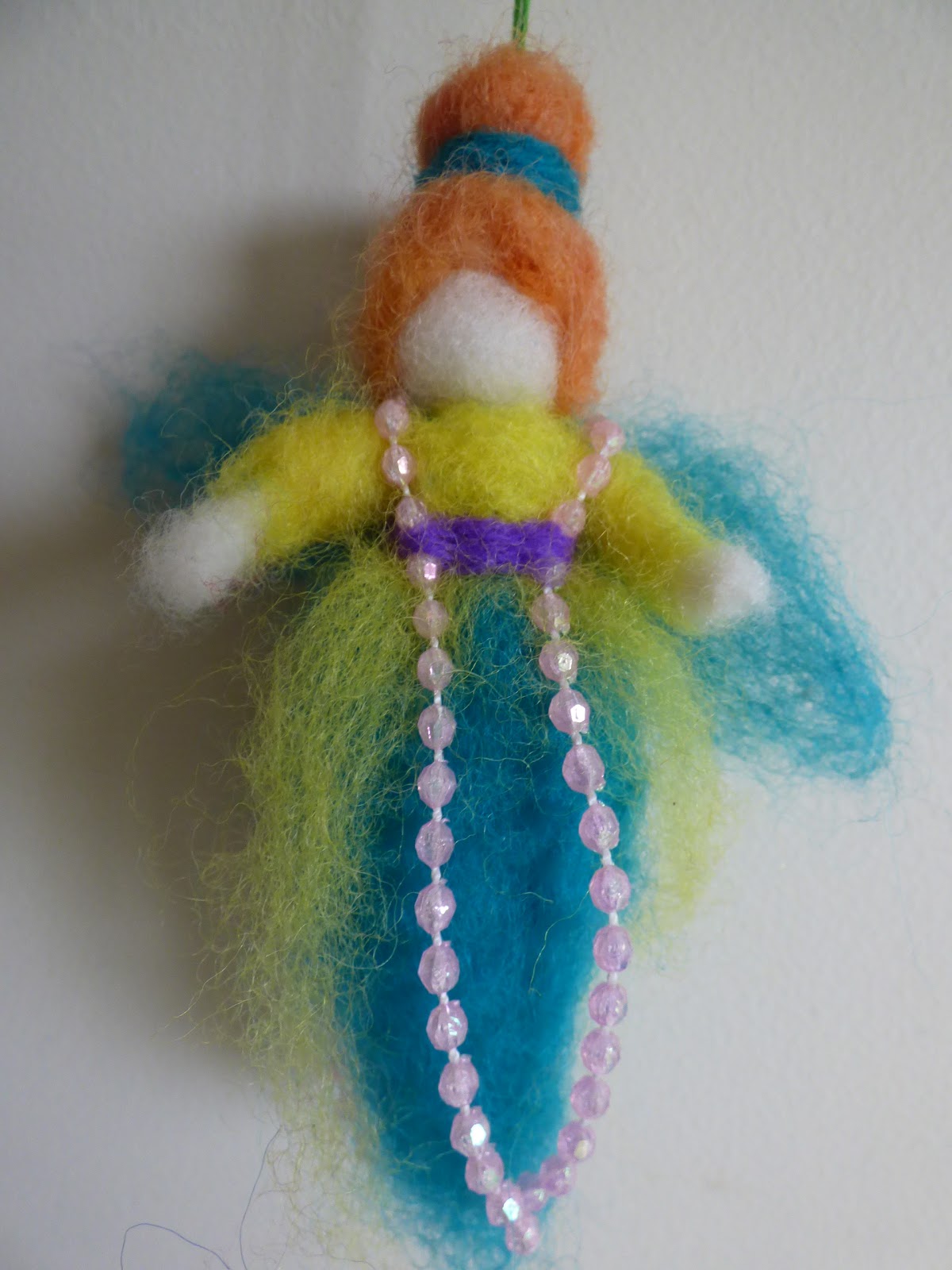
The beaded strands is held into place with wool roving wrapped around the waist and stabbed into place to secure.
To secure the feathers into place at the back, I placed a piece of wool roving over the ends and stabbed it into place.


 I made the miniature flowers using a small piece of pipecleaner, and a scrap of felt rolled into a flower shape.


 The stars were made from bondable Angelina fibre which I ironed; then I used a little star sticker as a template and cut around it on the Angelina to create the stars. I sewed the stars into place, and put one star in her hair. I put a bit of Angelina fibre in the wings as well (not ironed), to add a little bit of sparkle.


 I need a new stick - am running out of room.


 I used a bit of ribbon folded over into the middle, as wings.


 This angel is wearing a white feather boa - very glamorous!
 I used corriedale/sheeps wool as the base of the angel and her dress; but I used a merino/silk/corriedale mix for over the top - it feels so soft and silky.

I plaited her hair at the back.

 A multicoloured angel, with different colours around her skirt as well as over the top.
 This is the back of the multicoloured angel.

 A rainbow inspired angel, complete with rainbow wings, and holding a miniature heart. I sew the miniature hearts into place.


 I quite like using a variety of colours on the dresses and reflecting the colours in the wings.
 48 angels hanging off a stick.


 I am being brave and using different colours for the hair - previously I have tried to go for natural coloured hair. I rather like this little angel with her yellow dress and pink hair.


Saturday, 8 April 2017

Needlefelted Fairy Mobile Tutorial


I made this fairy mobile for my niece's 8th birthday. I was on a strict budget and did not have a lot of money to spend on birthday presents. But I do have lots and lots of coloured wool roving in my craft room, so all I needed to buy was wire. This mobile cost me very little money (less than $2) and a bit of time. 

You will need:  
* Wool roving - This is carded, unspun wool. Carding wool is a process that combs wool fleece and makes it usable. You probably want a variety of colours. There are a number of options if you wish to dye your own wool - my mum used to use food colouring to dye wool; Fruits, flowers and vegetables can be used to dye wool, eg onion skins, and beetroot; Otherwise, you can purchase dyes from craft shops and wool shops.
* Wire
* Pliers
* Felting Needles. These are special barbed needles that come in a variety of sizes. 
* Felting Mat or thick sponge pad.  Car wash sponges work well.

First, bend the wire into a circular shape to the size you require. I made two rounds, twisting the ends of the wire around the circular shape. 
Then get a decent length of wool roving and begin wrapping it tightly around the wire shape, until you reach the desired thickness. You want it reasonably thick, to be able to felt it using needles without hitting the wire all the time and bending your needle. Unfortunately I don't have photos of this part, as I didn't think about doing a tutorial until I began adding the flowers and details.  But you get some idea of the thickness in the photo. Once you have wrapped the wool around, put it on your felting pad or sponge, and begin stabbing it with your needle (this is a great way to get out any frustration that has been building up inside you). Use a large size needle to begin with, and use an up-and-down motion, rather than side to side (otherwise you risk damaging either your needle or yourself - and trust me, it hurts!). Try to avoid the wire as much as possible, but make sure you rotate it and felt the whole thing evenly.  Add more wool if some parts are skinnier than others.  Change to a smaller needle as the wool fibres begin to mesh together. 

 I learnt how to make angels from wool roving in an online tutorial. There are many tutorials online that show you how to make them. I just omit the wings and add a little bit more roving to the skirt to make fairies such as these. When I first began this fairy I made her arms rather short (as you can see) but I added extra wool to her arms to extend them, and you can see the difference between this photo and the photo of the finished mobile. 

Once you have felted the mobile's base, you can begin adding detail. To create flowers, get a tiny little bit of wool roving between your fingers and wrap it around your little finger to make a ring shape. Take it off your finger, squash it together onto your base, and begin stabbing it in.  
O
Once you have stabbed in the flower, you can add a centre.  Get a tiny bit of a different colour, and roll it into a little ball between your fingers. Place it into the centre of the flower and stab it in using a fine needle. I use a size 34 or 32 for fine detailing - whichever feels best.
Repeat until you have the desired amount of flowers. You can use this technique to add flowers to fairies' hair; dresses; whatever you are creating.
To create a ladybird, get a small amount of red wool and roll between your fingers to create a small ball.  Rolling it between your fingers helps prepare the wool and shape it ready for felting. Stab it into place. Get a tiny amount of black (eg 2-3 threads) and roll into tiny balls to felt into place on the ladybirds back. You will need to use a fine needle for this.  Get some more black to felt for the head and the line between the wings.
The rabbit was created by rolling a fat oval and stabbing it into shape; 2 little ovals for the ears; and a small ball for the head. It is ok if things are not perfect straight away - it takes time, and at first it often feels like it is looking like nothing you had imagined.  That is ok.  Keep stabbing, add more wool if you need to; and if it really turns bad, pull it off and start again.  
The toadstools were made by rolling fat sausages for the stalks and stabbing roughly into shape and then stabbing into place. You do not want to over felt something if you are going to attach it - you want to keep the fibres where it is to be attached, fairly loose, so that it can be felted into the attachment.  It is difficult (ie, impossible) to attach firmly felted items to something, and vice versa. When making the toadstools, you need to keep the top of the stalk loose, so that the tops can be felted on.
To create the tops of the toadstools, roll some red wool into shape and stab over the top of the stalks. You might want to wrap the red wool around the stalk, so that it is firmly attached to the toadstool. There is no right or wrong way - do what works with you, and give yourself the freedom to experiment and try things out and don't give up if it is not working straight away.
Roll a little bit of white roving between your fingers and stab into place over the toadstool tops.

To add writing, take a long, thin piece of roving and roll it between your fingers into a thin line. Place into shape and use a fine felting needle to stab into place.


To create the butterfly, get a small piece of roving as in the above picture. I used two colours. Roll the roving into a ball and place on your felting pad. Stab into shape. I used the finer needle down the middle to create shape.  Remember that the more you felt something, the more the fibres mesh together and shrinks in size. Get a small piece (a few strands) of black.  Roll between  your fingers to create a line and place over the middle of the butterfly; stab into place using a fine needle.
Once you have created your butterfly, place on your base and stab into place.
The dragonfly was created by mixing a bit of sparkly non bondable Angelina with wool roving, shaping into thin lines and stabbing into place.

I hope this has helped to inspire you to have a go at felting if you haven't already.

You can find my other needlefelting tutorials here...
 Felted Balls


Friday, 7 April 2017

Felt balls

Fairy mobiles using felt balls at the top of the mobile.

These felt balls are a mix of needle felting and wet felting. I have tried making wet felted balls before, but they didn't turn out very well, and had huge cracks in them that I couldn't fix. But today I tried a combination of wet and needle felting, and they turned out great.

You will need:
* Wool roving, or carded sheeps wool
* Felting needles. I get my needles from Cobweb Cottage. They have a great source of information on the different needles and what they do.  When I started out, I only had one size, which was a thick needle. When I first found Cobweb Cottage, I was confused about the needles so just bought a set of 4 different sizes and I have learnt so much just from using them and getting the feel of them.
* A pad or sponge to work on. Car wash sponges are nice and thick to use, if you are just starting out.
* Dishwashing liquid
* Latex gloves
* Hot water
I get a lot of wool from my mum, who uses it for spinning. Mum cards and dyes her own wool, and spins it.  She often gives me the left over bits that she can't use for spinning.
Get a handful of wool.

Roll into a ball, as tight as you can make it. The ball will shrink in size substantially (about a third) by the time you have wet felted it, so allow for shrinkage.


Using a coarse needle (I use size 38) place the ball on your felting pad or sponge and begin stabbing the needle into the wool. Use an up and down motion rather than side to side, otherwise you may break the needle. Keep rotating the ball around so that you needlefelt the whole ball evenly at the same time.


Once the fibres begin to mesh together, use a slightly finer needle, such as a size 36. Keep stabbing and rotating the ball around so that it felts evenly.

I find that the sizes of needles are a bit like the gears of a car.  The size 38 is first gear, and is great for bringing the loose fibres together.
Size 36 is like second gear. Once the fibres have started felting, the larger needle becomes a bit more harder to use. Switch to 36, which is slightly smaller and is better for making your felting firmer as it can easily get into the already felted fibres.
Size 32 is a fine needle, which is great for finer details and finishing.


One thing about felting, is that the more the wool is felted, the more resistant it is to the addition of new wool, or to join on to another piece.  To add on more wool, such as if you have used one base colour for the shape of the ball and you want to add another colour, make sure you do so while the fibres are still loose, so that they will mesh together.


Keep stabbing using an even up and down motion, rotating the ball around, to mesh the fibres together.


Once you have needlefelted the ball firmly, it is time to wet felt it.  This process causes the ball to shrink even further as the fibres felt together. You may want to wear rubber gloves for this, to protect your skin from the hot water, and if your gloves have a bumpy surface, it also provides a bit of friction.
Squeeze a little dishwashing liquid onto your ball.
Put a little hot water onto your felt ball, and begin rubbing it into and around the ball. You want to create friction, as the friction in wet felting is what felts the fibres together. You only need a small amount of water to get the fibres damp and activating the dishwashing liquid. Press firmly on the ball as you rub and rotate it around, to felt it evenly.
The ball should start becoming more compact and smaller. Keep pressing firmly, rolling and rubbing. You can wrap it in bubble wrap to help provide a bumpy surface, and roll it around.

When it is nice and firm, rinse under hot water to wash out the soap.  This could take a few minutes. The hotter the better - hence gloves, to protect your hands.  The hot water felts the wool even further and finishes the process.

Place on a teatowel and leave in warm place (if possible) to dry.  This could take a few days to fully dry, depending on the weather and humidity.


One of my balls began forming a crack in it.  I took it back upstairs to my craft room and pulled out my needle felting needles and foam pad. Using a fine needle (size 32), I began stabbing around it and over it, to close up the crack. Then I wet felted it all over again, and the result was excellent - I could no longer see the crack!


When dry, use the felt balls as you wish to create a range of toys or home decor...

I used a needle and strong thread to make these fairy mobiles. The needle passed right through the middle of the felt balls, and I was able to do a couple of stitches in to the ball, top and bottom, to prevent the ball from sliding up and down.


You can find my other felting tutorials here...